
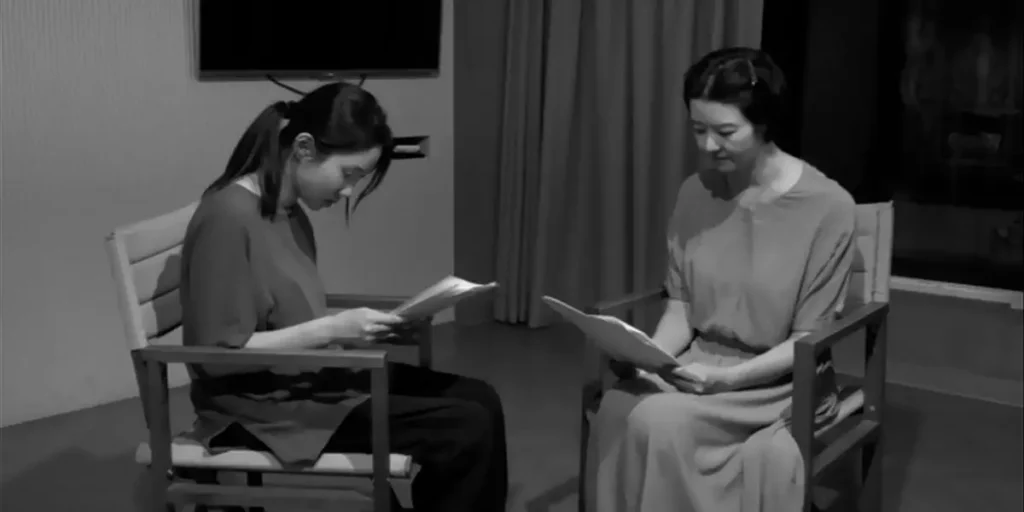
Hong Sangsoo’s The Day She Returns blurs performance and memory, balancing gentle humour with a quietly didactic tone.
Director: Hong Sangsoo
Genre: Drama
Run Time: 84′
Original Title: Geunyeoga Doraon Nal
World Premiere: Berlinale 2026
U.S. Release: TBA
U.K. Release: TBA
As expected for those already familiar with writer-director Hong Sangsoo’s cinematic language, The Day She Returns (Geunyeoga Doraon Nal) captivates through a light touch of humour, nuance, and the intentional repetition of everyday gestures. Song Sunmi (In Our Day, Walk Up) plays an unnamed actress who decides to return to the independent film industry after a discreet divorce while raising her 11-year-old child.
Divided into five simple segments, the film documents a single day in her life, from three interviews promoting her newly released production, organised by a director heard only in voiceover, to her decision to take an acting class to refine her technique after a twelve-year absence.
The Day She Returns opens in the corner of a German restaurant, where the first interviewer lowers the shade to soften the overexposed light as they sit by a window-side table. The two are positioned diagonally in a way that foregrounds Song’s face; she smiles constantly and tries her best to provide satisfying answers to every question.
The conversation unfolds with the quotidian rhythm typical of Hong’s earlier works, circling her current state as a returning actress. Here we encounter Hong’s signature elements: zoom-in camera movements, witty dialogue believed to be inspired by his personal experiences, the favoured black-and-white cinematography, and even the recurring veneration of beer that his characters revel in.
Within these simple yet demanding long takes, Song delivers a compelling performance, conveying confidence, uncertainty, and subtle emotional shifts as the conversations evolve. Through nuanced body language and facial expression, she reveals how her responses fluctuate between sincerity and guardedness. The more she attempts to disclose, the less genuinely new information she seems able to provide, an effect that tests both her patience and her sincerity. Though she appears encouraging and composed before the interviewers, signs of weariness surface in momentary yet discernible gestures during intermissions.
Notably, compared to many of Hong’s previous projects, The Day She Returns centres predominantly on women, aside from a brief appearance by the actress’s assistant friend. This shift moves away from the intersexual dynamics Hong often explores, broadening instead its examination of memory and relationship dynamics brought by interaction between two individuals.
Similarly to Tale of Cinema and In Front of Your Face, Hong continues to blur the boundary between fiction and reality, probing the instability of identity and the limitations of language. When the actor performs her role as an actress, to what extent is she being truthful to herself and to her words? One may observe that the dialogue becomes more conclusive and polished in rehearsal than during the interviews, where subtle differences and even hints of restrained aggression emerge.
Hong also incorporates details drawn from his own life. The restaurant setting, for instance, is reportedly near his residence; he is known to frequent the establishment for its beer and sausages. During the interviews, the faint sound of chopping in the kitchen underscores the realism of the environment, grounding the conversations in lived texture.
What dilutes the film’s dynamic arrives in its final chapter, in which the actress is asked to reenact the conversations that have just taken place. Paired with another trainee (Park Miso, also a regular in Hong’s recent films), she revisits and reexamines her exchanges with the interviewers.
However, the dialogue gradually loses its balance between seriousness and playfulness, drifting into an unforeseen life-advice-like didactic turn. The actress repeatedly emphasises the importance of authenticity and reflects on the complexity and endurance of individuality as she consults her notes. Such philosophical dialogue adds weight to the film’s more overtly reflective tone, slightly reducing its usual sense of ambiguity.
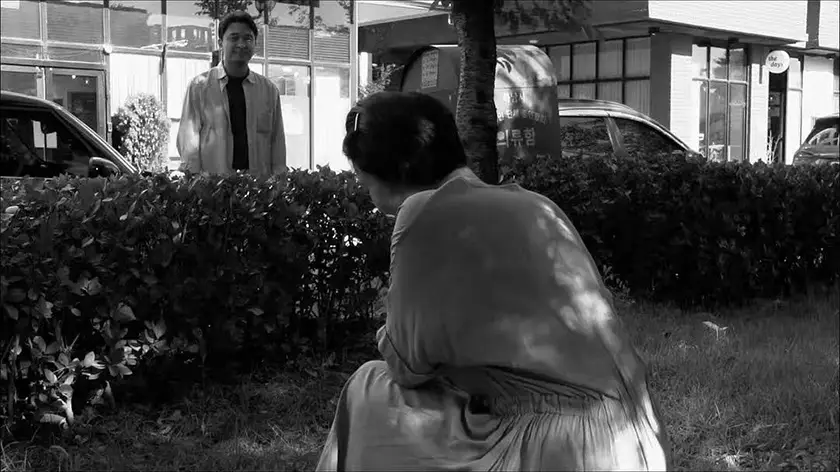
Whether The Day She Returns plays as a series of aphorisms or edges into didacticism ultimately feels secondary. What matters is Hong’s idiosyncratic humour and his precise attention to the subtle differences within seemingly unremarkable moments. Here, he turns once again to questions of memory and lived experience. As one character observes during rehearsal, what matters is simply what appears before one’s eyes: the immediacy of perception. It is in these fleeting instants that experience acquires its true weight. Such moments continue to define the quietly adoring world of Hong’s cinema, lingering well beyond the film’s final frame.
The Day She Returns (2026): Movie Plot & Recap
Synopsis:
After completing an indie film, an actress struggles to recall details from her three press interviews when asked to recreate them during her acting class.
Pros:
- The film centres on women, marking a shift from Hong’s usual heterosexual dynamics.
- Song Sun-mi delivers a nuanced performance, balancing confidence and vulnerability.
- Hong blurs reality and performance, merging memory with staged experience through repetition.
Cons:
- The final chapter leans toward a didactic, almost life-advice-like register, which risks diluting the film’s characteristic ambiguity.
The Day She Returns had its World Premiere at the 2026 Berlinale.