
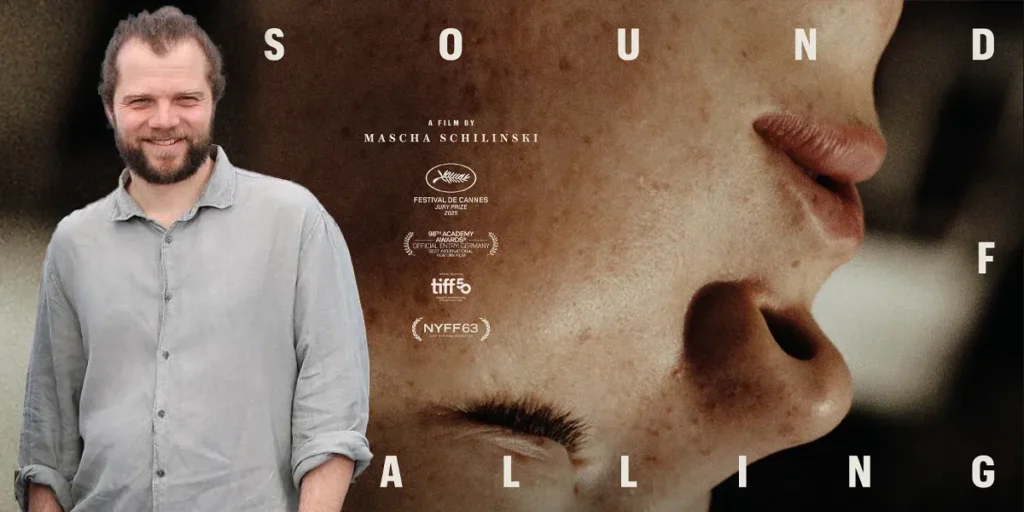
We interview cinematographer Fabian Gampfer to discuss the visual language of Sound of Falling and his collaboration with Mascha Schilinski.
Since its premiere at the Cannes Film Festival, Sound of Falling (In die Sonne schauen) has lingered in the minds of its audience, leaving behind the sensation of something that’s only partially grasped – a film experienced as much through images and sounds as through narrative. Widely regarded as one of the most technically impressive works of the past year, the film unfolds as a stream of consciousness shaped by memory, loneliness, generational scars, and phantom pains.
Directed by Mascha Schilinski and photographed by Fabian Gampfer, Sound of Falling traces the lives of four generations of women living in the same house across the twentieth century, moving between four distinct time periods, from the 1910s to the present day. Rather than drawing explicit narrative connections, Schilinski and Gampfer filter this continuum through the subjective perspectives of multiple characters and through the “gaze” of an elusive presence — a ghostlike, imaginary entity, evoked by a persistent drone — that inhabits the house and observes recurring patterns in their lives. Meaning emerges gradually through imagery and meticulous sound design, inviting the viewer to actively assemble the film’s emotional and temporal architecture.
Among the many accolades cinematographer Fabian Gampfer has received so far are his inclusion in the Academy Awards shortlist for Best Cinematography, a nomination at the European Film Awards, and the Silver Frog at Camerimage last November. We sat down for an interview with Gampfer about his collaboration with Mascha Schilinski, his use of lenses and film grain to evoke the texture of memory, and the main challenges of shooting Sound of Falling.
Fabian Gampfer on his Collaboration with Mascha Schilinski on Sound of Falling
Can you tell us about your collaboration with Mascha Schilinski? You also shot her first feature Dark Blue Girl (Die Tochter), which is a very underrated movie in my opinion.
Fabian Gampfer: Thank you. She’s also my wife. We met at film school, where we had the opportunity to shoot a couple of short films together: it gave us the chance to really get to know each other creatively and to figure out how we wanted to make films together in the low-pressure environment of student projects. That was great. What’s very special about Masha, as a writer and director, is that she thinks very visually. From a very early stage, when she’s developing an idea for a film, she already has strong visual concepts in mind.
Since we are a couple, I’m usually around when those ideas start to take shape, or when she begins to write – in this case, with [co-writer] Luisa Peter. So it’s not like I receive a finished script one day and the clock is suddenly ticking, giving us a few meetings to figure everything out. The process really starts much earlier, sometimes at the breakfast table, just talking about ideas. For me, working with her is a very enjoyable and creative process, because once you’re shooting, everything is scheduled and you have to work fast. Things have to be done in a structured way. Having more time beforehand allows you to think freely, be radical, follow an idea and then realize, “Okay, this doesn’t work at all, let’s do it differently.” I really enjoy that, and I think it helps you make films the way you truly want them to be.
So you were involved from the first day on Sound of Falling. Was that the case for any other technical departments too? As you said, the film has this strong visual language not only because of the images, but also because of the sound and the production design. I was wondering if this work was conceived from the first day, or if at the beginning it was mainly between Mascha, Louisa Peter, and yourself.
F.G.: In the beginning it was the three of us; Mascha and Louisa were looking for ideas, and at things both of them had been thinking about for a long time, which were difficult to put into a screenplay. Mascha said that at first she thought maybe it’d be better to write a novel, or do a sound installation or something, because the ideas they had were really about subconscious things and the subject of transgenerational trauma –d things that are in the subconsciousness and that are really important for us, but that are hidden, and that we don’t share with other people. And the process of writing the screenplay took quite a while.
Once they found this farmhouse, it kind of became a vessel for this film, and then they designed this whole thing around it. But it really wasn’t written as a typical screenplay – where you’d just have an indication of the location where the scene takes place, then dialogue, and then the next scene – because there’s almost no dialogue in the film. It was written more like a novel, and very much also including how the images feel, but also the sound. She had very clear indications in the screenplay of what the sound would be like: it was all thought through like this. And then, at a certain point, all the other departments came on board, and it became a very nice collaborative way of working on those things and finding solutions for how exactly to do them. We had [sound designer and editor] Billie Mind on board early to discuss what the sounds could be like, but also other sound artists, and all these things came together.
Shooting on Digital and Creating the Film’s Aesthetic of Memory
The movie was shot digitally. Have you ever thought about shooting it on film? Were there budget issues or other kinds of obstacles?
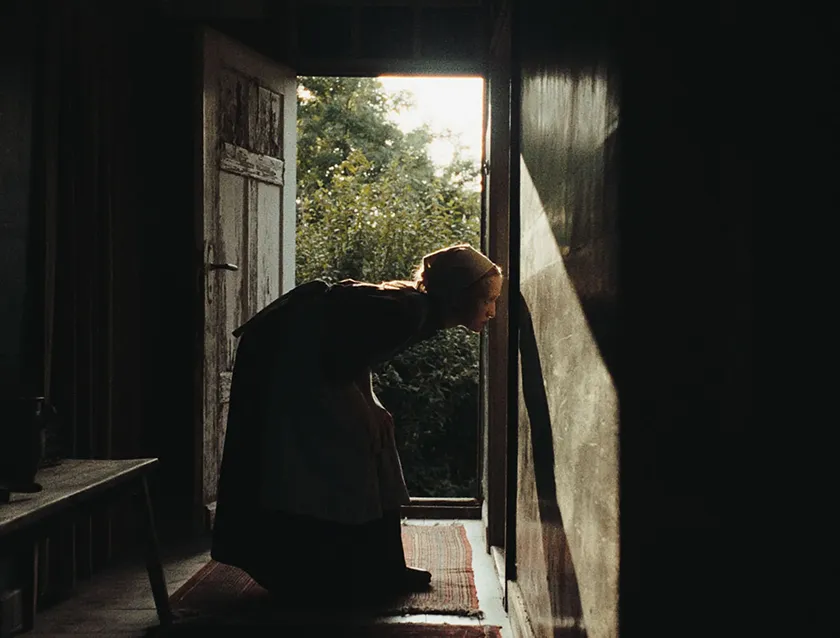
Fabian Gampfer: So the first thing we thought was that we wanted to shoot it on 16mm, because it’s so much about memory. The whole structure of the film works not in a classical narrative way, but more the way memory works. We didn’t want the images to be clean and sharp; they needed to have this kind of veil on top of them, a bit like memory itself. You can’t properly grasp how things looked back then, when you try to remember them.
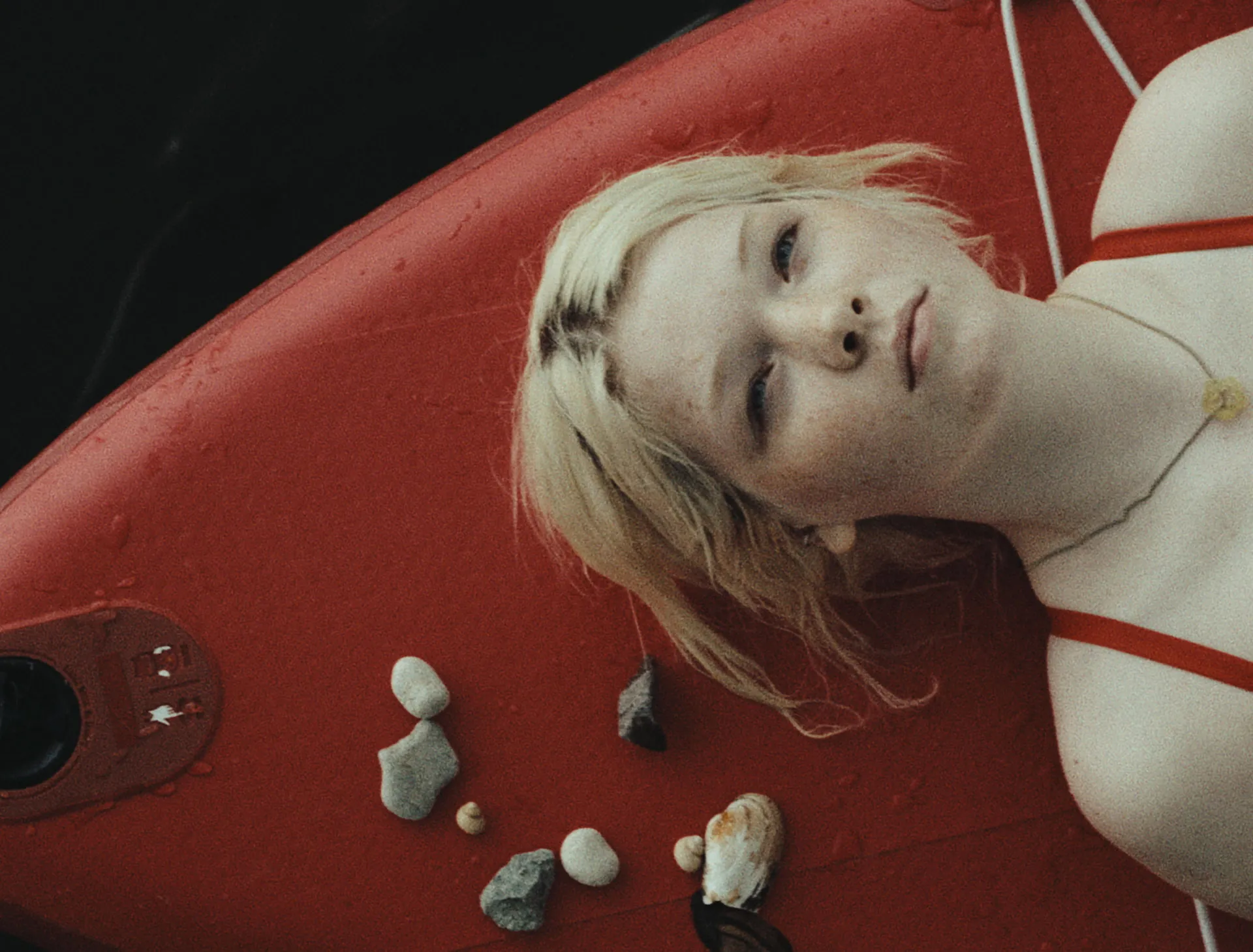
So this was the idea, and we thought the graininess and the kind of focus you get with a 16mm lens would be the thing to do. But then it was a budget issue: we couldn’t shoot film at all because we had to work with a very small budget. And this actually opened up a lot of possibilities. We added the grain, the sharpness, and the halation: all those effects you would get with 16mm, in post-production. But since we were shooting digitally, we also had the option of using different sensor sizes, and I started the process of testing and exploring different lenses and optical effects.
We followed this process of thinking: what do the images in our head actually look like when we remember something? At a certain point, I really started closing my eyes and remembering things from a long time ago, for example the image of a grandmother who passed away. You can’t properly see her face the first time you remember it, so it takes a while. Maybe something comes back, but it comes back from another scene. I really loved this process of finding optical effects that have that kind of quality. I tested a bunch of things, and we ended up using a pinhole lens, which is not really a lens; it’s just a hole that you put in front of a sensor, and it gives you a very defocused kind of image. It had a very special feel to us: it felt like it had come from a long time ago. In this way, we developed a palette of different optical effects that we then used. Taking that path opened up several possibilities, because the look isn’t uniform: it doesn’t all look the same.
I was very interested in the way you used all these layers of blurriness, especially because in some sequences you employed a bokeh effect that is not perfect — very imperfect — which adds to this sense of memory. There are also other kinds of blurriness. For example, in Irm’s birthday scene, when her car is stuck between the two trees, there’s a subtler texture to the image.
Do you and Mascha have any criteria when choosing which kind of layer of blurriness to apply to a specific sequence, or is it more a matter of intuition about what works best for that moment?
F.B.: The first thing we were trying to do was a motion blur effect, because we were very much inspired by photographers like Francesca Woodman, who works a lot with motion blur in her pictures and creates this very ghost-like feel. But then I did some tests, and I didn’t find a proper way of doing it that would work well for motion pictures. You could blur the image a little bit, but it wouldn’t work in the same way it does for stills. So it was a bit of back and forth, and we eventually found a new effect.
One thing I discovered with this blur approach was that I could take a still photography lens, open it, and reverse the front element. That way, you get a very extreme blurriness in the corners of the image, while the center stays kind of sharp. I did some tests, and we thought about where we could use it, because it looked very interesting. But we still felt that the center being sharp didn’t really match how memory works. It was a nice effect, but it wasn’t quite there yet. So the next step I took was to twist the camera 90 degrees and then choose the frame we wanted to use in the film, where one part of the image would be blurred and the other part would be in focus. We felt that this could have been useful for moments where you don’t fully remember something and want to place the blurriness very intentionally. We got a really nice effect out of this technique and used it that way.
So overall, it was very much a trial and error process, figuring out how to do it and where to place it. It was very clear that some moments in the screenplay needed something like that, and then it was also about figuring out which approach fit where.
Fabian Gampfer on the Camera as a Ghost-like Presence in Sound of Falling
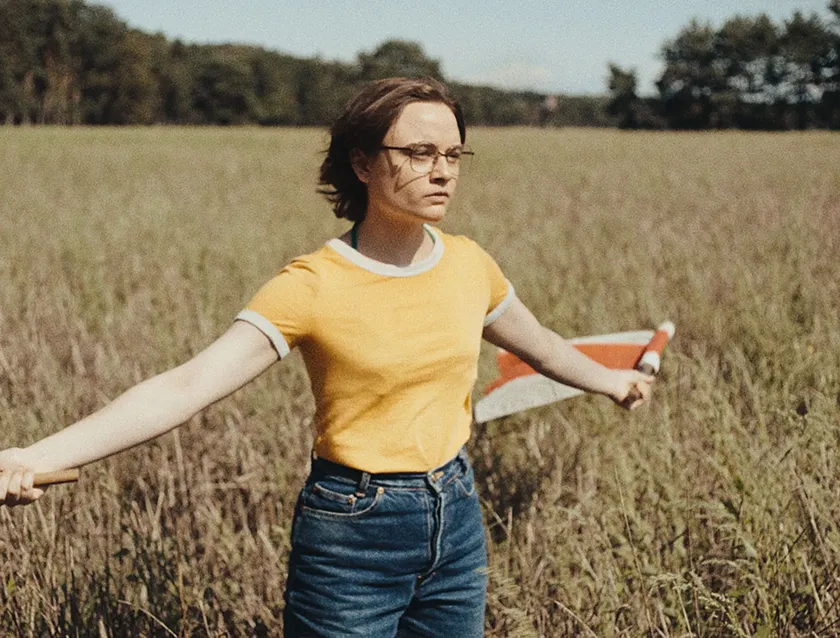
What I found remarkable about the movie and the camera movement is that not only do you follow the subjective perspective of the main characters, but the camera also works as a ghost-like presence, almost like a drone that follows all the narratives.
Fabian Gampfer: At one point during the preparation, we found a photograph related to this farmhouse location, which had been abandoned and empty for a long time. As part of the process, it was very interesting for us to walk around, explore the farmhouse, and find objects from ancient times that people had simply left behind when they moved away. This photograph showed maids standing at the farmhouse, and I believe it was taken around 1920. There were some chickens standing there as well. When we looked at the picture, we realized it was the exact same wall behind them that we were seeing to this day.
That gave us the feeling that it was the same place, but in another time, where very different things had happened. These were very essential, dramatic things that had taken place in that exact spot. I was standing there, doing something very simple, like looking at my cellphone, but with this photograph, and also because the maids were looking directly at the camera, we suddenly felt very connected to them. From that came an idea: what if we could move around in this place not only through space, but also through time, and explore this kind of transgenerational trauma? What connection do those people have with us? Their lives and what they went through certainly affected the generations that came after them, including ourselves. So this photograph became a big inspiration for the camera: we started to see it as a camera concept. We wanted the camera to really feel like a ghost, to give it a kind of body or character, so that you’d feel its curiosity as it moves around. It looks at the place, but also at people, and it has the ability to travel through time, to look around corners, but in another time.
This collapse of time makes it feel as if time doesn’t really exist anymore; the camera can just follow whatever feels interesting. The actors were also aware of the camera as this ghost. They worked with the idea that, although the characters don’t know each other because they belong to different generations, they can somehow feel each other’s presence. Then there is the breaking of the wall, when they look directly at the camera. You don’t really know whom they are looking at; it’s the camera, but in a way, they are also connecting with each other.
It was a great choice, because when they look at the camera, it’s not about how we’re looking at the ghost, how we’re looking at the next generation, or how we’re looking at the audience. It’s breaking the fourth wall, but in a very original way.
There’s a sequence I’m particularly fond of: the long take in the first narrative, during the family dinner. The camera moves between spaces and then into the room where the father and the grandma are. Can you tell me something about that specific sequence?
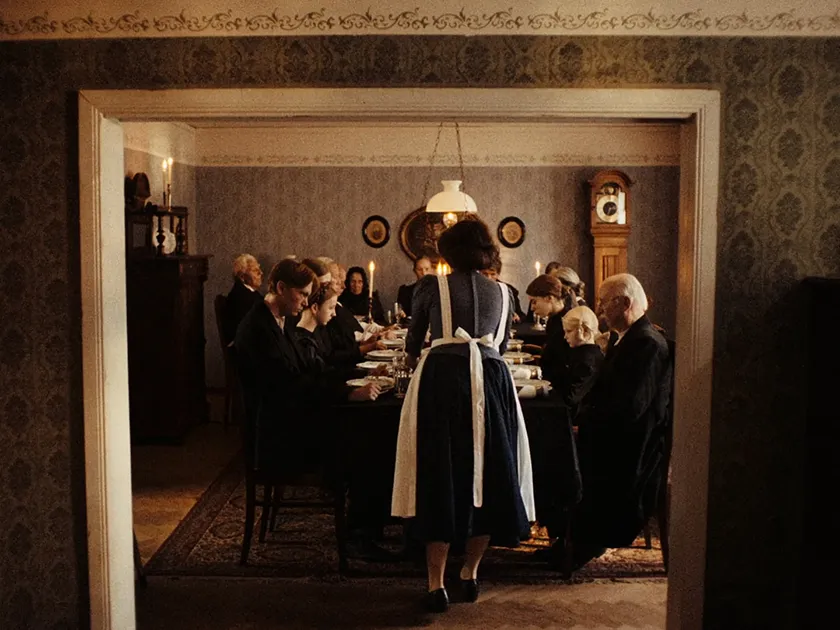
F.B.: It was something we thought would be very effective, because it captures the atmosphere. The whole sequence [a long single-shot in which the camera explores the spaces of the house as the family gathers for dinner, with children playing or dancing while the adults talk or eat] is kind of a core moment for getting into the film and into the subject. The celebration starts during the day. Little Alma sees the post-mortem photograph, and her story begins. Then we transition into the night, during the night celebration. When the night starts, the sequence is very much about the atmosphere there. We thought it would be a great moment to have a one-shot camera sequence. As I said, the camera is like a ghost with its own personality, being there, curious, floating around, observing.
It was nice to design this scene. Mascha worked with the actors, and we didn’t have a lot of time, but at that point, there was a real atmosphere. It was very dimly lit with candles and old lights. What helped me a lot was using a camera with very high sensitivity, so we could really rely on those candles to create the mood. The people were in a very small room, which was also a nice setup for us because it became very organic and there weren’t too many things happening. We took the opportunity to orchestrate this one-shot sequence, where the camera is just moving around through the space.
Challenges, Working with children and Creating Continuity with Four Narrative Timelines
What were the biggest challenges while shooting the movie? Were there any logistical challenges?
Fabian Gampfer: The whole thing was a big challenge, mainly because it was in the same building, and the same room, but in different time periods. That meant that after shooting one time period, everything had to be switched and redressed for the other time periods, which we would shoot afterwards. Initially, we had to make a schedule that finished one time period and then moved to another, and then another. There weren’t that many exterior scenes, but we would have to shoot exteriors in between, because we couldn’t stop shooting.
Then we had another problem: we shot with so many children, and children are only allowed to work for three hours a day. But we had to generate full shooting days, so we couldn’t just work for three hours. Sometimes we’d try to get scenes from another time period with other cast members on the same day to make a full day. Then we also had trouble with the weather: it was often raining, so we had to switch things around. All of that made it very complicated to generate a schedule that worked, and we had to work at a really fast pace.
But it was great, because the whole team, and also the village where we shot, really took part in this process. After we started, I think everybody really began to like what we were doing and put a lot of positive energy into it. Somehow, things that seemed very difficult and challenging became possible. For example, we could only do a very limited number of takes at all times, just because of the small amount of time we had. But that led to very high concentration from everybody: they were fully present.
The whole village liked it a lot that we were making this film there. The farmer gave us his field and didn’t wait with the harvesting, so we could shoot our scene there. The ancient machinery they still had, they brought it to us and helped. We said: the village made this film. From all of that, there was a very nice, positive creative energy among everybody that carried us through the shooting process.
Is there any sequence that you struggled to shoot despite all these logistical problems?
F.B.: I think every sequence had its very specific kind of problem. Night scenes were particularly challenging. One issue was logistical: because of the children, we were not allowed to shoot at night, so we had to shoot those scenes during the day. Then, since the camera was sometimes traveling from one room to another, there were a huge number of windows. A simple thing like blocking all those windows in a short time with a limited number of people was very challenging.
Also, as it’s usually like when you want fluid camera movements and to travel through a lot of space, you have limited possibilities for how to light it. This was a big challenge. I had a very great crew working with me, trying to find solutions. My gaffer, Oliver Geissler, was really committed to that. We had to find ways to use light mainly coming from outside during the day, but also at night, while hiding our film fixtures and rigging them into the ceilings.
At the same time, we were developing a concept that relied heavily on practical lights, so the light source could actually be within the frame. This allowed us to move more freely with the camera. This solution often involved the art department a lot, because we had to make sure the light fixtures were period-correct and placed as people would have positioned them. But it was also about how to light the scene properly, giving exposure to the faces and shaping the lighting. So it was really a collaboration between those departments, figuring out which practical elements to use and where to place them.
Visual Continuity and Thematic Echoes between Sound of Falling and Dark Blue Girl
Outside of the lighting, I feel there’s a continuity between the four narrative lines. Was that something you were aiming for?
F.B.: Totally. Normally, or often, you would have one timeline that is the main time, and everything that is not happening there would be treated as a flashback or a memory. You would then apply a different look, desaturated or some other stylistic approach, for the other times, so the audience would understand it’s a flashback.
For us, it was really the opposite. We conceived the whole film as a memory scene. The idea was as if, a thousand years from now, those people are remembering what happened back then. We wanted to show not the difference, but to bring those times together, as if time didn’t exist, and to have them interfere with each other. Quite early on, we decided it should have the same look, a consistent LUT and stylistic approach for all the times. We then obviously had to make sure the audience could understand it was different times. But with the set design, the costumes, and just the actors, the number of people present and what they were doing, whether using a cellphone or farming, it became quite obvious it was another time period. So we didn’t need to create additional stylistic choices to make it clearer.
To conclude our conversation, Sound of Falling engages deeply with the idea of voids, with characters who are drawn to the thought of jumping. Thinking about this, I was reminded of the opening shot of Dark Blue Girl, which is framed from the point of view of the main character looking down from a sea cliff.
Do you see a connection between these two images, or between the way both films approach this sense of attraction toward emptiness?
F.G.: It’s a nice connection, I’m glad you made that. In Dark Blue Girl, the narrative structure was a bit different; it’s more plot-driven than Sound of Falling. But even then, we were very interested in the atmosphere and in creating images that would connect to something more unconscious.
In Dark Blue Girl, we shot on a Greek island early in spring, when it was almost empty. There were these rocks, the sand, the architecture, elements that allowed us to find images with a darker tonality, something that resonated with the inner states of the characters. In that poetic sense, you could definitely draw a comparison with Sound of Falling. The opening shot of Dark Blue Girl actually emerged while we were shooting another scene at the beach. We were standing there, watching the waves come in, and once you frame it and add a bit of slow motion, you start to lose the sense of what is stable and what is moving, the entire image seems to drift with the water. It felt right for the subject of the film and for what the girl is experiencing.
That shot was really found on location, by placing the camera and thinking, “This might work.” Later on, it became clear that it should open the film. Usually, it’s a process of gradually understanding what a film is really about, what lies beneath the surface, what works on a subconscious level. I really enjoy searching for images that resonate in that way. Often, it’s at the beginning or the end of a film where you want to place them.
Thank you for speaking with us!
This interview was edited for length and clarity.
Sound of Falling will open in theaters in New York on January 16, 2025 and in Los Angeles on January 23, with a national rollout to follow. In the U.K. and Ireland, the film will be released in cinemas on March 6.
Header credits: Poster for Sound of Falling (Courtesy of Mubi) / Fabian Gamper attends the Sound of Falling photocall at the 78th annual Cannes Film Festival at Palais des Festivals on May 15, 2025. (Daniele Venturelli, WireImage)