
From its ending to its political allegory and dystopian world, we look at why Planet of the Apes (1968) still matters today.
Planet of the Apes (1968) follows astronaut George Taylor (Charlton Heston) after a disastrous space mission strands him in a world where apes rule, and humans are treated as little more than feral bodies. Wounded and unable to speak, Taylor falls under the care of two sympathetic chimpanzees who see in him a cute pet and a troubling exception: an intelligent human their society cannot easily classify. What follows is both a fight to survive and a struggle for recognition, as Taylor tries to prove who he is, cross a society built on his degradation, and find some way off this planet of apes.
For many viewers, Planet of the Apes (1968) begins and ends with its famous twist. That image has become so iconic that it overshadows everything else in the film. But Planet of the Apes still matters because the world before the twist is what gives that ending its force. Released at a moment of deep social and political unrest, the film remains far more than a science-fiction landmark, and here’s why.
Why the Ending Still Works Today
Before its ending lands, Planet of the Apes already gives us a whole society to look at. The apes govern, preach, police, classify, and punish. Seen from the outside, it is absurd, even funny at first: a whole civilization of apes mimicking the rituals and authority of human institutions.
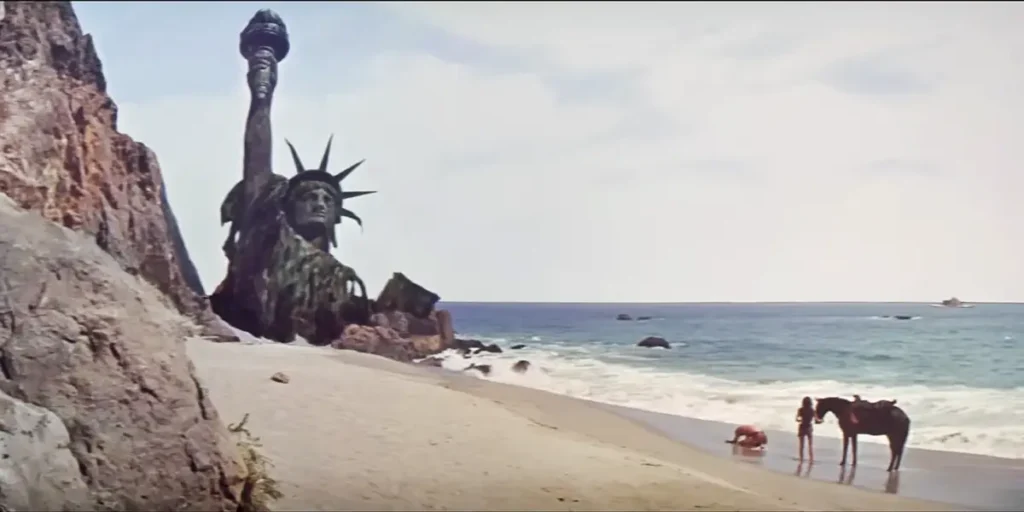
Then the ending turns the whole film back on us. After escaping Ape City, Taylor reaches the shoreline and finds the Statue of Liberty half-buried in the sand. The image answers the question the film has been building toward all along: this is not another planet, but Earth in the far future. The humans did not lose power to apes on some alien world; human civilization destroyed itself, and ape society rose in its place. That is why the ending still lands so hard. It reveals that Taylor has really been looking at the ruins and aftermath of human history, not a bizarre society on a planet far from ours. In that instant, the joke ends.
The ending still works because it reveals that the violence and logic of the ape society are not as distant from human society as it first seems. Before the final shot, we have already seen a world built on policing, punishment, censorship, and pseudo-science. The Statue of Liberty changes how we read all of that because it shows that this order grew out of the same human history Taylor thought he had left behind. That is why the ending still hurts: the film stops being about a world we can judge from a distance and becomes about the world that produced us.
The Political Allegory Behind Planet of the Apes
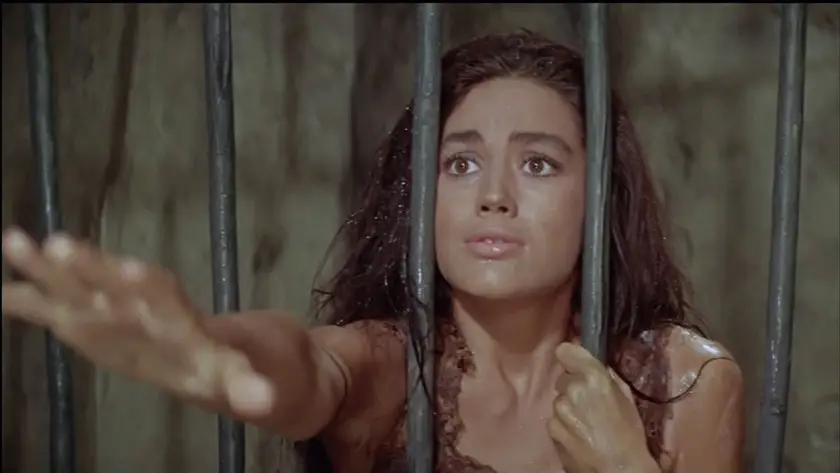
In Planet of the Apes, apes rule, and humans are hunted. The gorillas are the police and military force: they hunt, beat, capture, and enforce. The orangutans sit closest to power, guarding law, government, and religion. The chimpanzees work as scientists and doctors, but only within limits set by the order above them. Nothing in this society is random, and not all lives matter.
The film makes that order explicit through religion. The teachings of the Lawgiver shape ape society, a foundational figure whose words function as sacred text, moral instruction, and political doctrine at once. Those teachings present humans as inferior creatures driven by violence, lust, greed, and destruction. In practice, that belief gives ape society a ready-made justification for treating humans as less than fully sentient beings. Religion here helps organize power, giving prejudice the weight of tradition and making exclusion look righteous.
Dr. Zaius (Maurice Evans) sits at the center of that machinery. As Minister of Science and Chief Defender of the Faith, he is an orangutan who controls both what can be known and what must remain forbidden. He is also one of the film’s key antagonists, an authority figure charged with protecting the ideological order. Zaius is one of the few apes who understands that primate society was built on the ruins of an earlier human civilization, and that knowledge shapes everything he does. He knows Taylor is dangerous because he threatens the silence that keeps ape society stable. When Zaius says the great desert of this world, the Forbidden Zone, “was once a paradise” and that humanity destroyed it, he turns history into a tool of repression, using the past to justify censorship and control in the present.
The film says this out loud through the apes’ sacred text. The Lawgiver warns, “…beware the Beast Man, for he is the Devil’s pawn. Alone among God’s primates, he kills for sport or lust or greed. Yea, he will murder his brother to possess his brother’s land. Let him not breed in great numbers, for he will make a desert of his home and yours…”
There is a clear modern parallel. Hard politics become most brutal when they are aimed at whoever arrives from outside, whoever does not fit, whoever can be labeled invasive, contaminating, or less than fully human. Taylor is treated exactly that way. Before he is heard, he is classified and contained.The same logic shows up in foreign policy when exclusion gets justified as a necessity and then sold as common sense to keep our nations safe. We still use the language of security to make detention and forced removal sound reasonable. In that sense, Planet of the Apes lasts because it shows how states protect themselves, treating some lives as threats before they are treated as people, way beyond a Cold War nightmare.
Why Planet of the Apes Still Feels Radical
One reason Planet of the Apes still feels radical is that it does not treat oppression as random cruelty but as a full system. By the time George Taylor is brought before the apes, the film has already shown how that system works. Humans are hunted in packs, rounded up with nets, locked in cages, examined like animals, and stripped of speech before they can even be understood as persons. Taylor survives that violence, but his voice makes him truly dangerous. The moment he speaks, the whole logic of ape society is threatened. Now the cage is not enough.
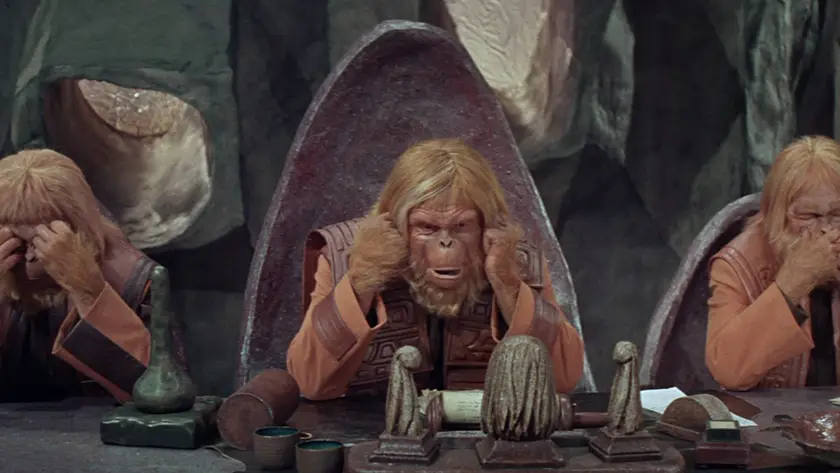
That is why he ends up in the courtroom. Taylor is there because the system needs to decide what to do with an exception it cannot absorb. If humans are supposed to be mute, inferior creatures, then a speaking human is destabilizing. The monkeys in robes are funny for about 10 seconds before the scene turns harsher. The orangutans reject what Taylor represents because they know he could damage the order they defend. Dr. Zaius understands this immediately: he knows that if Taylor is allowed to be fully legible as a speaking, thinking being, then the hierarchy separating ape from human starts to crack.
That scene still cuts. It is about whether institutions can survive an inconvenient fact, not about fairness. Evidence matters only when it confirms what the mighty already want to believe. The trial begins with a touch of absurd comedy and ends in something genuinely suffocating. By the end of it, the law is blocking the truth instead of enforcing it.
Released in 1968, the film emerged into a world already saturated with that kind of pressure. The United States was deep in the Vietnam War, and the Tet Offensive had shattered the fantasy that the war was under control. Martin Luther King Jr. and Robert F. Kennedy were assassinated within months of each other. Cities were marked by racial conflict and social unrest. Protest was everywhere, but so was the language of order, discipline, national survival, and fear of collapse. Public trust in institutions was breaking down. Planet of the Apes absorbs that atmosphere completely, and ape civilization runs on the same logic.
Why Planet of the Apes Still Matters
Planet of the Apes still matters because it schemes oppression as a system of structural segregation. Long before the Statue of Liberty appears, the film shows a society built on fear and censorship. Taylor’s tragic journey through that world gives the film its lasting power. He is studied, humiliated. He is forced to prove his humanity to an oppressive structure composed of individuals who are not human. By the end, the film has already made its point that civilization hardens into institutions and dogmas before collapsing.
Planet of the Apes shows how prejudice cloaks itself in the language of order and self-preservation, just as truth is quickly swept under the rug when it threatens power. The final image matters because it strips away the comfort of distance. Taylor is staring at the ruins of his own world, and so are we.
Planet of the Apes (1968) is now available to watch on digital and on demand.