
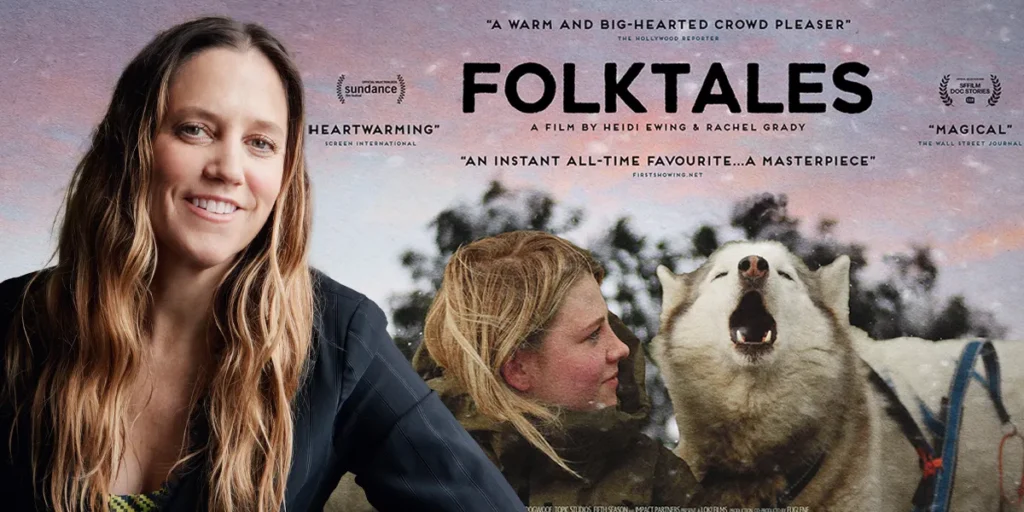
We interview director Heidi Ewing about her new documentary Folktales, working with teenagers, folk high schools and more, ahead of its release.
Co-directors Heidi Ewing and Rachel Grady headed north of the Arctic Circle for Folktales. There, they found Pasvik Folk High School, where young people are educated in ancient ways, taught survival skills, and leave behind much of what makes being a teenager today so damaging.
It’s a place where the group is prioritised over the individual. The selfishness of social media is replaced with connecting with people, nature, animals. A key part of the curriculum involves bonding with a husky. The students learn to take care of something other than themselves.
The whole environment is a radical departure from how most of today’s younger generations have been raised. To capture it, Heidi Ewing had to be careful not to interfere with the school’s process, while being reactive to the students’ development. Folktales focuses on three young people’s experience of the school, but one unexpectedly quits halfway through, only to return later. She tells us what it’s like to lose one of your main characters, what it means to be a teenager today, and whether she thinks folk high schools look more towards the past or the future.
Read our interview below!
Heidi Ewing On Working With Today’s Generation Of Teenagers In Folktales
Folktales isn’t your first time working with teenagers. You’ve been featuring them in your films for a couple of decades now. What have you found has changed about what it means to be a teenager in that time? What does it mean to be a teenager, now, when we meet them in your film?
Heidi Ewing: That’s a great question, because it’s been over 10 years since we made a film about teenagers and they’re very, very different. I really wasn’t prepared for how different. I don’t have children; I have nieces and nephews, but I don’t live with a teen.
We found them to be interestingly guarded with the camera around. They’re used to controlling their own self image. They invented the selfie, they self-record, they grew up with Instagram and TikTok.
It was a big ask to have somebody else be in charge of their image and to trust us to film them during all the contours of their day and their year. It took a long time to gain that trust, much longer than in the past.
It might have been because of the type of kids we were filming. Scandinavians aren’t like Americans, in the sense that Americans love the attention and they’re gregarious. Scandinavia is a more stoic culture. Our third main character is Dutch, so it could be cultural, but I think it also has to do with this generation. They’re so techno savvy, and they see people rise and fall with the wrong video on the internet, and so it took them a long time to trust us.
The film is about going out into nature away from modernity. How do you make sure that your tech, your cameras, and the young people’s sense of being on display like on social media, don’t interfere with what they’re experiencing at the school?
H.E.: We’ve always favoured long lenses, but in this case it was extreme. We used mostly zoom lenses, a 70 to 200 millimeter, and then we ended up getting a 1,200 millimeter, which is like a safari lens.
The students obviously knew we were filming, and our sound man was in the area, but sort of hidden. They didn’t really want to see us. They didn’t mind being filmed, but also, we didn’t want to destroy their experience of nature and of solitude. A lot of the experience is about going out on your own and building a fire and doing it for yourself, so you don’t want to be close to them so they can turn to you and be like, ‘Hey, Heidi, can you help me light this fire?’ So we stayed way back.
Aside from the long lenses, the young people didn’t like to have radio mics put on them. So our sound man, who was just nominated for a beautiful prize in the United States for his sound work, had to have handheld microphones in the vicinity and hang them off of trees and things like that. So we worked around the preferences of the students.
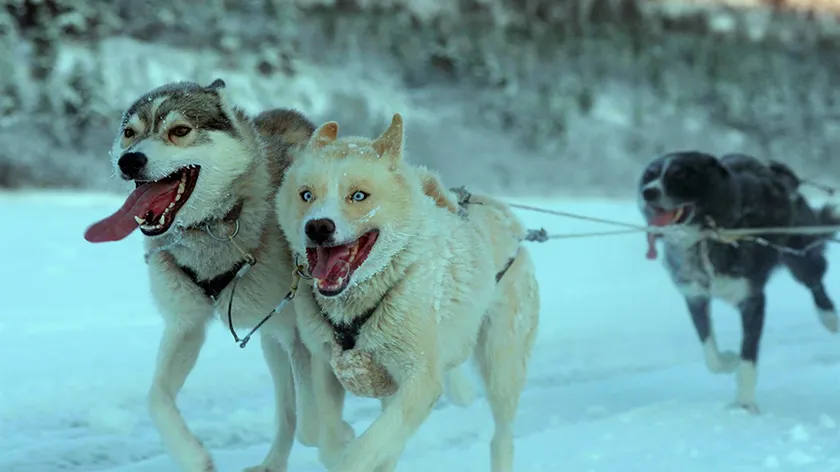
And then there was the environment. It’s negative 30C, batteries would only charge for a couple of hours, the drone kept falling out of the sky and breaking, and filming dog sledding is virtually impossible. You can’t put your cinematographer on a sled, the camera is too heavy, so you have to be on a snowmobile. It was way more technically challenging than I had thought, and I’m kind of glad I didn’t know, because I think I would’ve thought twice about making the movie.
The sound is amazing. The huskies’ paws on the are so relaxing, it’s like ASMR.
H.E.: It’s funny because we would shoot and then our sound man, Andreas Lindberg Svensson, would be like, ‘can I go out now on my own?’ So he would go out alone with the dogs and someone would drive the sled so he could get all the sounds that you hear in the movie.
Heidi Ewing On The Ups And Downs Of A Folk High School And Working With Huskies
I feel like Folktales is an inherently positive story about a good idea run by good people. The young people seemed to benefit from real self-development. The high school took them away from what wasn’t serving them.
What’s the catch? In what way is the system not perfect?
Heidi Ewing: Well, the return is hard. Spending a year in this very warm-hearted, tolerant community, where people aren’t swiping or hate-watching… The students sort of lose interest in their phones because nature competes very strongly. But landing back in society is rough, and you see a little bit of it in the movie. I don’t know if maybe there’s something folk high schools could do to prepare people for the real world again.
But the thing is, the folk high school is trying to prepare people to be stronger adults. Part of that is about leaving the iconic and idyllic environment of the folk high school. But I think it’s really hard for the young people to come home, and most of their friends don’t want to go camping in the woods.
H.E.: They use the lessons from the past and from our human ancestors to fortify the modern human being.
So, if you’re in a situation where most people are passive and soft and can’t do anything for themselves – which I think includes most young people right now – then teaching these sorts of old-school things, like hunting and fishing and running with dogs and gathering bark and kindling to keep yourself warm… Sure, they might feel outdated, but they build an I-can-do attitude, which I think is absolutely crucial to live in 2025 and 2026 because there are so many things dragging you down. There’s the news, there’s the economy, there’s social media.
I think looking to the past can fortify yourself to become a more steely adult.
It’s mentioned in the film that huskies can say, ‘I see you. I like you, I want to be with you’ to the young people. What was it about the relationships the young people had with the huskies that couldn’t be replicated with peers or their teachers?
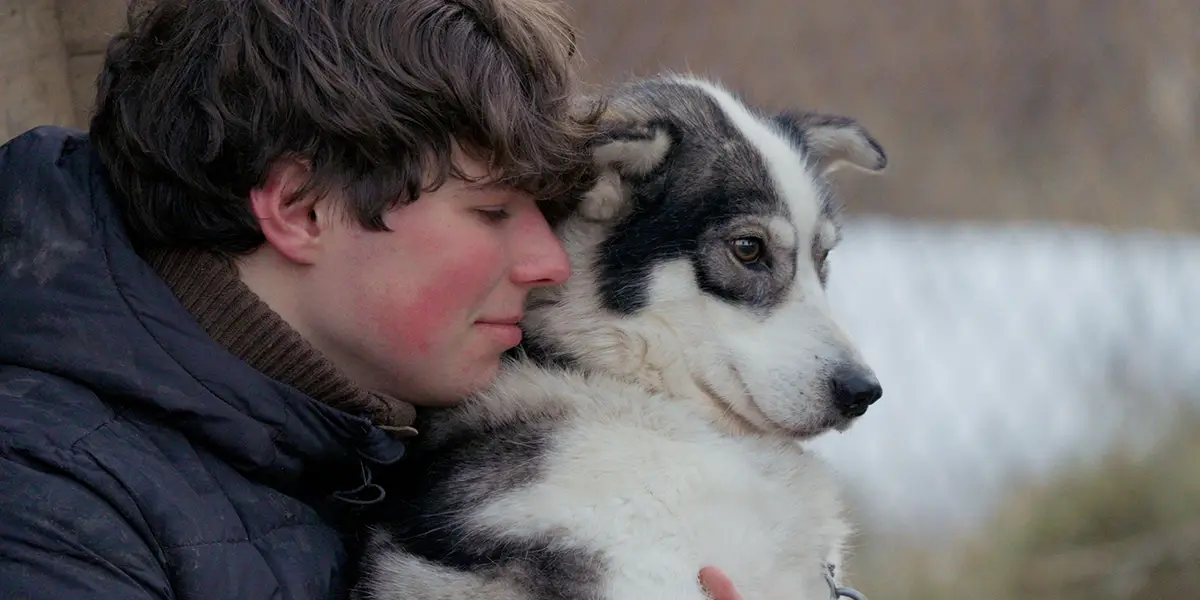
H.E.: You can’t say no to a husky. You can say no to a human being. The way the huskies jump on the kids and put their paws around their neck: They look you straight in the face and they’re like, ‘I have needs, take me out skiing, take me out running, pat me, bathe me, right now’.
They get your attention and you need two hands. You can’t be holding your phone when you’re dealing with huskies, or you’ll just be knocked right over.
I think those relationships made the students feel that they had a stronger purpose, in relation to the dogs, than they might feel with their friends or their family. Their value wasn’t based on the funniest quip or how handsome they were or what great story they had to tell, so I think the social pressure that they feel with one another just goes away with the huskies.
“he Kind Of Ghosted All Of Us For A While” – Heidi Ewing on Romain and How Folk High Schools Bring People Together
One of the young people, Romain, doesn’t come back after the winter break. From a filmmaker’s perspective, what is that moment like when someone you’ve been following effectively drops out of the process?
Heidi Ewing: It’s worrisome, but we’ve made so many films before, you have to be open to any eventuality. That was just the story we would have told, that the school wasn’t right for him. We would’ve found a way to end his story, maybe we would have gone back to the Netherlands at the end to check in on him.
But to be completely honest, we were far more concerned about his personal and social wellbeing, his self-worth. We were very worried that he would not overcome things in his life, because he would have dropped out of something again. He had dropped out of high school, and then to drop out of the programme, we felt like it would’ve had a lasting negative mark on his life. So we were actually more concerned about what was gonna happen to him as a person by dropping out.
And he kind of ghosted all of us for a while. About six weeks, two months later, he came back on his own. He missed it. He wanted to finish something and we were so happy that he came back. As a filmmaker, it’s inconvenient, but as a human being, we really wanted him to succeed at something. We were so overjoyed when he came back.
I keep seeing the phrase lately, ‘everyone wants to live in a village, but no one wants to be a villager’. It feels like Folktales is advocating for being a villager. What do you think it was in particular about that environment that brings young people together?
H.E.: The philosophy of all the folk high schools, passed down from their initial founder, Grundtvig, a Danish priest, is that the whole thing is about the village, the community, the democracy, articulating kindness to one another, being held responsible for being unkind. It’s an active part of the folk high school, they don’t hide it. Every one, if it’s Christian, non-Christian, secular, if it’s whatever, all of them have this spirit of we’re one community and you are a part of it.
It’s in the movie. One of the kids, Bjørn Torre, makes a mistake with a dog. He takes one out without permission and the dog gets injured. There’s a moment in the scene afterwards where they say, ‘everybody makes mistakes, but you’re not here as an individual, you’re here as part of a group’.
It’s articulated like that at folk high schools, and I think it’s hard for people. We’re in a highly individualistic society and a highly individualistic moment in history where everyone has become a brand of some type in their own mind.
So I think it was alarming to be brought back to the past, to the village, where you are just one vote, especially for some of the American and non-Scandinavian students who hadn’t heard this kind of language before. It’s startling at first, and it took people some time to start falling into the community.
But it’s so gratifying at the end, when they’re all singing in one voice. It’s not about sublimating your talents or your personality or your individuality. It’s just about finding your place in a group as well, and I think you can do both.
That’s what a folk high school teaches. And the folk high schools are a bit at risk right now from losing funding. A lot of these countries are rethinking it. Some attendance is down. I would be really sad if this aspect goes away because they are putting humanity front and center. How to be a good human being is the point. There aren’t a lot of aspects of society where you can say that’s the focus.
Thank you for speaking with us!
This interview was edited for length and clarity.
Folktales will be released in U.K. and Irish cinemas and on digital platforms on 5 December, 2025.
Header credits: Heidi Ewing (Mei Tao) / Folktales poster (Dogwoof)