
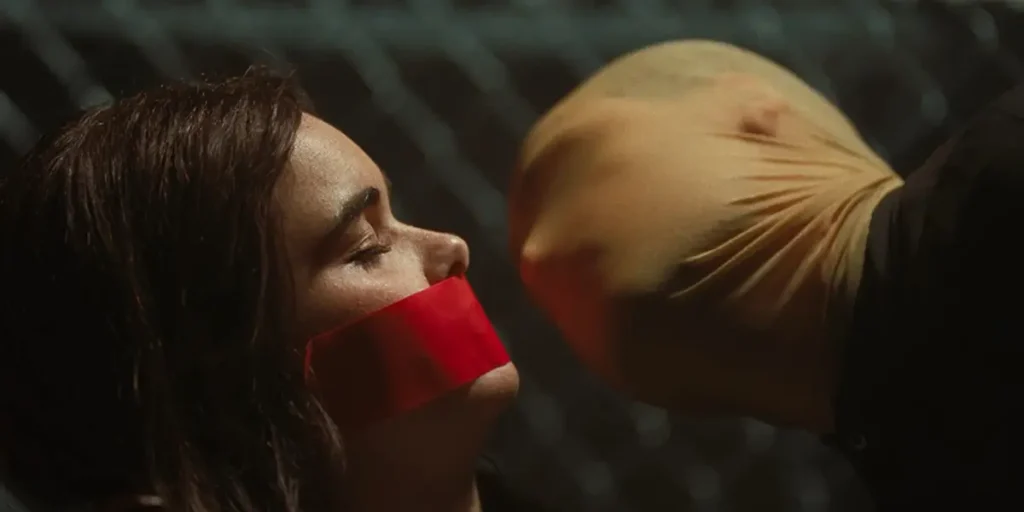
Daniel Goldhaber continues his studies of social media culture by smartly reinterpreting Faces of Death through the lens of TikTok virality.
Director: Daniel Goldhaber
Genre: Splatter, Horror
Run Time: 98′
Rated: R
U.S. & Canada Release: April 10, 2026
U.K. Release: TBA
Where to Watch: In select theaters
“If I can get closer to God by eating brains, why not?”
In an era when professions are being devalued in favor of content creators and “social media influencers,” and most of our time on this planet is spent on computer or phone screens, a remake like the one Daniel Goldhaber and screenwriter Isa Mazzei lay out with Faces of Death might be the year’s timeliest release.
Reinterpreting Gorgon Video’s mondo horror movie for the TikTok generation certainly sounds like a daunting task. The 1978 version of Faces of Death was essentially touted as the “world’s first viral video” before the internet was ever a thing, as it asked its adventurous viewers to bear witness through one agonizingly gruesome death scene after another. Some of it was real. Some of it was staged. All of it was pure, unwatchable trash that only gained cult status by “daring” the audience to sit through sequences of beheadings, mutilations, and assassinations, to name a few, until they’d numbed themselves to such senseless violence.
In a way, this predated our current doomscrolling predicament, where we no longer emotively react to anything on our screens because they arrive at such a rapid pace. We can’t think – or sit with – the succession of news or videos we fleetingly observe. We’re also always distracted by our social media notifications, even in a work environment. That’s why, whenever something significant appears on our algorithms, the quantity of information is too much for the human brain to bear, so it has automatically numbed itself to an active response of fear or distress.
This type of numbness is what initially causes content moderator Margot (Barbie Ferreira, of Bob Trevino Likes It) to believe that a beheading video she is asked to review is fake. Margot works for a TikTok-inspired social media app called “Kino” and views hundreds of videos that are reported to be potentially in violation of its Community Guidelines. She’s completely indifferent to anything she sees on her screen, no matter how extreme, and uses her judgment to either remove a video or keep it up on the platform. Most videos she sees are kept up, no matter how irresponsible they are, yet doubt begins to cast in her mind when she views a series of death scenes that look staged, but feel extremely real.
These videos recreate key sequences from the original Faces of Death: the electric chair, the decapitation, the SWAT assassination, and the monkey’s head being smashed to death for its brains to be consumed. They’re the only reasons why Margot initially believed they weren’t real. However, when figures in the videos she initially approved to stay on the platform are reported to be missing, Margot thinks they are seeing the work of a deranged serial killer who vies to become an internet celebrity by “giving the people what they want.”
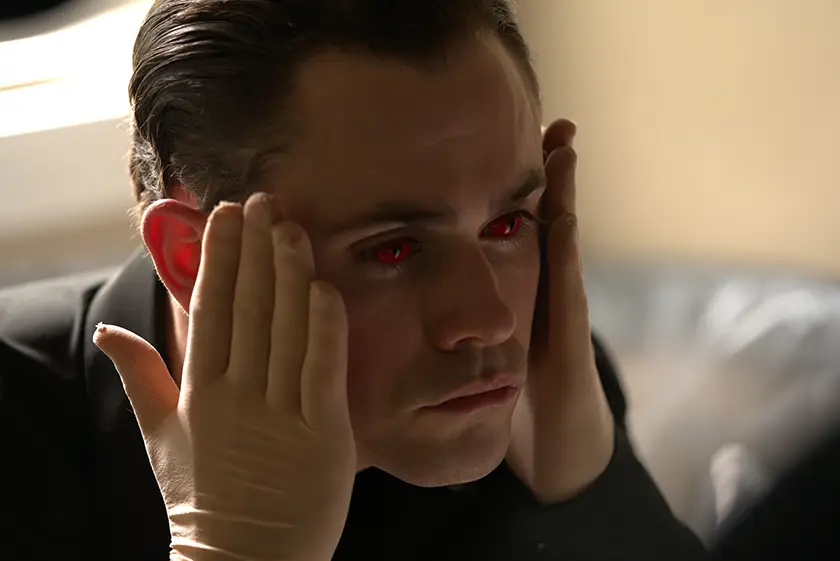
That’s where Goldhaber cuts to the killer in question, Arthur Spevak (Dacre Montgomery, of Dead Man’s Wire), and begins to find associations between the content moderator and the murderer, as Arthur tracks famous influencers online, kidnaps and forces them to become a part of his unofficial remake of Faces of Death that promises authentic murders, unlike the staged Gorgon Video film. It’s a big, uncomfortable ask for the audience to sit with such gruesome violence, but this reinterpretation of an otherwise meaningless piece of snuff film surprisingly finds meaning in the characters being presented on screen and their obsession with the World Wide Web.
Goldhaber’s filmmaking is immersive and dynamic. With the aid of cinematographer Isaac Bauman, he employs second screens to plunge us into the internet’s penchant for depravity and “extreme” content. Composer Gavin Brivik also creates a disorienting sense of tension through his anxiety-inducing music, which always puts us in total discomfort, even while being confronted with extreme violence.
In a way, this version of Faces of Death is in almost perfect communication with Pascal Plante’s Red Rooms, which also dealt with the subject of obsession, albeit in a more intimate setting, while Goldhaber paints it on a much larger canvas. Red Rooms focused primarily on the dark web, whilst Faces of Death shows that you don’t even need to go on the dark web to find acts of murder and death. They’re directly fed right to you by the algorithm you consume.
In that regard, the effect of viewing Goldhaber’s film is more immediate than the creeping sense of unease felt while watching Red Rooms, but both works of art complement each other. Many internet users believe the thrill of being online lies in seeing things they shouldn’t, that have fallen through the content moderator’s cracks, because the Community Guidelines being used to allegedly “protect” viewers are so arbitrary that a video showing someone getting seriously injured is fine for “entertainment,” but an infomercial TikTok on how to use Narcan to prevent overdoses gets removed.
That scene alone – and, by extension, this movie – might make the case against social media more than literally anything else. We’ve been told how bad it is, but haven’t had the wool pulled over our eyes in the way Goldhaber does here. It’s a platform designed to enslave and corrupt our minds until we can no longer think for ourselves, because our brains can no longer discern what is real or fake. So many of my journalistic peers now fall for obvious disinformation, AI deepfakes, or tricked videos, instead of verifying everything before commenting on a situation. They’d rather react to something at face value because their brains are conditioned to believe what they’re seeing, instead of thinking critically to properly assimilate that information.
Yes, Goldhaber’s Faces of Death is extremely disturbing. Perhaps a bit more than Gorgon’s film, because the commentary drawn over the course of its 98 minutes has something to say, and the thought behind it feels terrifyingly real. Our thoughts – and perceptions of reality – are being controlled by social media CEOs who don’t care if we fall prey to disinformation or develop mental health issues by spending our entire lives on their apps, and they certainly don’t care about safeguarding their applications and allowing for meaningful content moderation. At face value, the violence is shocking, but the layers behind every sequence have a profound impact on how we may ultimately perceive the digital world we live in.
Goldhaber does this through his dual perspectives: the moderator, obsessed with finding the killer, and the perpetrator, who wants to be revered as a pioneer in the “content creation” space. At some point, he blends the two together through an ingenious split-screen effect. Both Ferreira and Montgomery deliver performances of immense power and raw intensity, with the former surprising us with an erratic, nervous turn that slowly transforms into something much darker as we learn more about her past. Goldhaber and Mazzei might do a little too much in shoehorning lots of character development in such a short amount of time, but this is a small issue compared to everything else that works so brilliantly in a movie that is far better than it has any right to be.
The original Faces of Death might be an object of fascination, or a film you’d “dare” to watch as a teenager when you shouldn’t, but it’s not particularly interesting. Goldhaber’s remake improves upon the original intent of Gorgon’s movie by reframing it in a context that none of us can escape. We all (sadly) live through our screens. We’ve become obsessed with a world that isn’t real. Human connections are no longer the same with the advent of applications designed to keep us glued to our devices. Things aren’t going well, but companies are apparently “giving the people what they want.” I’m not so sure they know what “the people” truly want anymore…
Faces of Death (2026): Movie Plot & Recap
Synopsis:
Margot, a content moderator of a popular social media app, stumbles upon recreations of key sequences from the 1978 cult mondo horror film Faces of Death. She initially believes they are staged, but the death scenes become more and more intricate until she realizes that real people are being sickeningly murdered by a serial killer who is kidnapping famous internet figures to become a part of his “remake.”
Pros:
- Daniel Goldhaber smartly reinterprets Faces of Death to fit our TikTok-obsessed, content-creation era.
- What was once touted as “the first viral video before the internet was a thing” becomes the primary object to illustrate a clear fascination with “extreme” content online, even if people get seriously injured – or killed – in the process.
- Goldhaber finds meaning in an otherwise meaningless movie by drawing parallels to our current screen-addicted culture and initial encounters with traumatic cinema.
- Barbie Ferreira is a revelation, while Dacre Montgomery delivers the best turn of his career as the Faces of Death-addicted serial killer.
- Gavin Brivik’s score creates a disorienting sense of tension and anxiety no one can shake off, especially during the film’s bravura one-take sequence.
- Isaac Bauman’s photography is the best work he’s ever done, as Goldhaber discovers associations between Margot’s internet obsessions and the killer’s desires to become a social media celebrity.
Cons:
- The movie does a little too much in a short amount of time, but it remains hard not to think about it once it’s over.
- Anyone squeamish or prone to gore should not see this movie.
Faces of Death will be released in select US and Canadian theatres on April 10, 2026.