
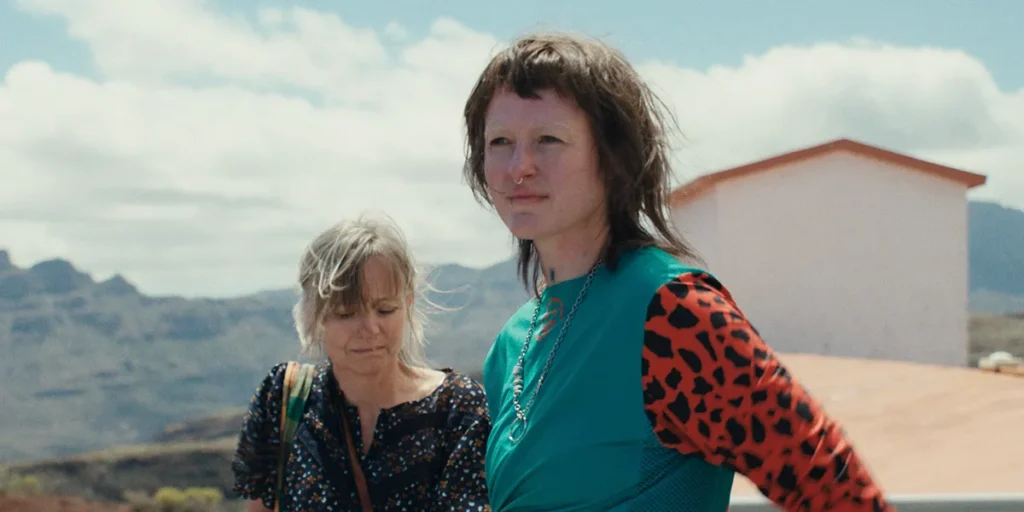
Itonje Søimer Guttormsen’s Butterfly is an unevenly interesting drama about trauma, family bonds and excavating the past.
Director: Itonje Søimer Guttormsen
Genre: Comedy, Drama
Run Time: 120′
International Film Festival Rotterdam Screenings: January 29 – February 3, 2026
Release Date: TBA
Itonje Søimer Guttormsen’s Butterfly is an interesting experience: a film that starts quite intriguingly, seemingly interested in exploring its characters’ trauma and roots, but that ends up feeling more like an artsy-fartsy acid trip. Achored by both Renate Reinsve and Helene Bjørneby’s excellent performances, Butterfly kinda-sorta works as a well-directed drama about a pair of sisters with a traumatic past.
Unfortunately, as the movie progresses, it gradually turns less and less interesting, descending into esoterism and the exotisation of traditions and rituals.
Reinsve plays Lily, a former model and current performer who lives in Hamburg, and takes part in art installations and plays around with videocameras and other lo-fi pieces of tech. Her older sister, Diana (Helene Bjørneby), lives in Norway and works as a kindergarten teacher. They haven’t seen each other in years, since they both lived with their problematic mother, Vera (Lillian Muller), in Gran Canaria.
They are forced to meet again, though, when Vera dies while performing a ritual in an abandoned astro-centre in the middle of the desert. Thus, the sisters travel to Gran Canaria to find out what happened to her, and most importantly, sort out her affairs. It turns out she owned the piece of land in which the astro-centre was built, and in which she lived with fellow esotericist, Chato (Numan Acar). But in order to inherit the place and probably sell it, Lily and Diana must contact all the other co-owners, most of whom took part in the same mysterious rituals as their mother.
The first half of Butterfly is its best, as we see a pair of sisters who couldn’t be any more different from each other trying to get along and find a way to find out who exactly their mother was and what she was doing in the astro-centre. The contrast between ice-cold Lily, with her bleached eyebrows and eccentric fashion sense, and the homely and shy Diana results in some of the film’s most entertaining and compelling scenes. Their dynamic is believable, and it works too, thanks to Reisnve and Bjørneby’s performances.
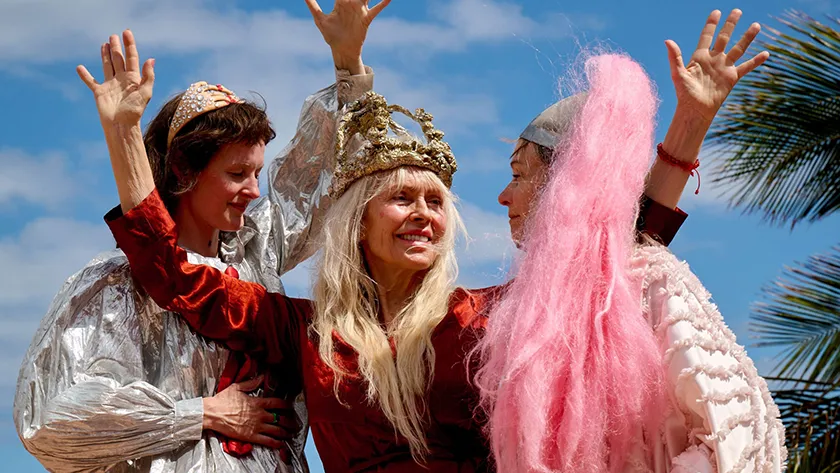
There comes a moment, though, in which the sisters are separated, and each has to take a different path, so to speak, in order to connect to their mum’s ways. It’s here that the film descends into madness, making the characters take part in rituals, change, apparently, because they find out the truth about their pasts, and in general, transform into gentler versions of themselves. Any kind of conflict that could have been found in the script disappears, and although we’re supposed to feel that both Lily and Diane have found… Redemption? Peace? A universal truth?… all I saw was a couple of European tourists starting to behave like locals because, through ancestral rituals and the occasional drug-taking, they have been enlightened, man.
I don’t want to sound reductive, but if I do, it’s because I feel the film is being reductive by showing the way its protagonists partake in rituals related to figuring things out about their past and their problematic mother (who, it turns out, used to struggle with depression, and probably suffered from bipolar disorder and even ADHD). By the film’s conclusion, I was left with the impression that most of Lily and Diane’s problems could have been solved years earlier through psychotherapy, but that, like many other white people, they end up going to another country to use another culture’s rituals, “find themselves”, and solve their problems.
Which is a pity, because the characters are quite fascinating, and once again, are perfectly portrayed by two talented actresses. Lily is someone who is clearly repressing something; a woman who has much to say but doesn’t really know where everything is coming from. Reisnve looks virtually unrecognisable as her, playing her delicately and realistically. And Diane is her total opposite; a homely woman who has dedicated herself to teaching kids, and who, through her kindness, has managed to hide many a secret about their childhoods (and possible abuse) from her sister.
I wanted to like Butterfly more than I did. I was fascinated by its main characters, and I do believe Itonje Søimer Guttormsen’s filmmaking is quite skilled, mixing “regular” footage with Lily’s handheld videocamera shots. Plus, the real locations in Gran Canaria are rather striking, and help to make the story seem more intimate and dramatic. But I’m not a fan of the film’s exotisation of the locals’ rituals, its apparent views on mental health and the way it must be dealt with, and its ending. Butterfly starts promisingly, but instead of transforming into something better, it unfortunately turns into something worse.
Butterfly (IFFR 2026): Movie Plot & Recap
Synopsis:
Two Norwegian sisters must travel to Gran Canaria to sort the affairs of their dead mother, an esoteric woman with mysterious ties to the locals.
Pros:
- Pitch-perfect performances.
- Well-developed protagonists.
- Interesting locales.
Cons:
- Gradually turns less interesting.
- Feels like it exoticises traditions and rituals.
- A very unsatisfying ending.
Butterfly premiered at IFFR 2026 on January 29, 2026 and will be screened again in person and online till February 3.