
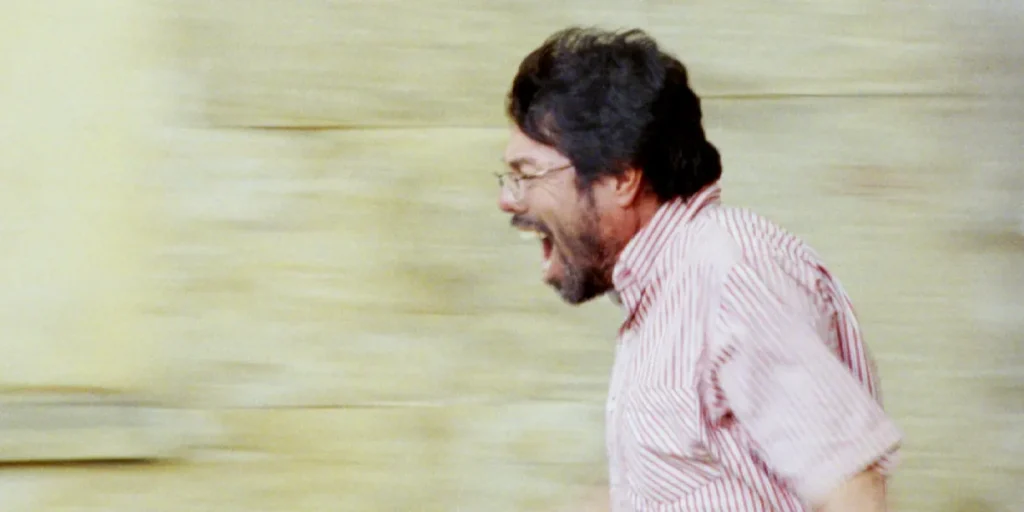
At the start of the year, Simón Mesa Soto’s A Poet already positions itself as an unforgettable film, one that is both morbidly funny and profoundly human.
Writer and Director: Simón Mesa Soto
Original Title: Un Poeta
Genre: Comedy, Drama
Run Time: 120′
U.S. Release: January 30, 2026 (limited)
U.K. Release: TBA
Where to Watch: In select U.S. theaters
Have you ever wanted to succeed at life, but felt like everything (and everyone) seemed to be stacked against you? This is the story of Oscar Restrepo, protagonist of Simón Mesa Soto’s insane A Poet, played by non-actor Ubeimar Rios. In fact, none of the actors who portray characters in Soto’s sophomore directorial effort are professional, adding to the authenticity and raw nature of a movie that begins with a relatively simple premise which blows out of proportion in ways that are similar to the work of Josh (and Benny) Safdie and Ronald Bronstein.
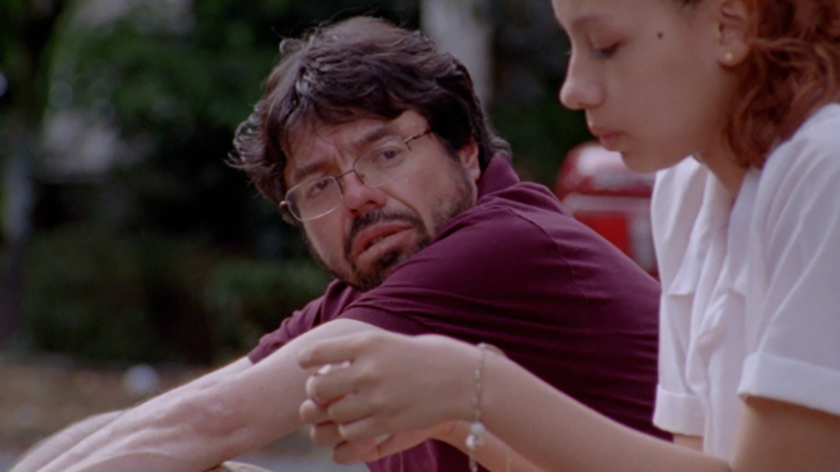
To say anything in detail about the movie would rob you, dear readers, of the pleasures in discovering A Poet for yourselves. Still, one must know that Restrepo’s poetry peaked early on in his career, winning an award for the work he crafted in two collections of poems he wrote, and that was that. He hasn’t been able to find a stable job in a while, as his erratic (often alcoholic) behavior pushes him away from the people who want to support him. After his sister helps him get a job as a high school professor, Oscar meets Yurlady (Rebecca Andrade), a gifted poet who could have a fruitful career if she wants to.
Oscar decides to help her out (read: mold her in his image), and things don’t go as planned. That’s as far as I’ll go, because the movie is best experienced knowing nothing of it, other than it will focus on a poet who’s strangely obsessed by the work of José Asunción Silva, and who goes so far as to hang a portrait of him in his office for inspiration. At first, Oscar is presented as kind of an as*hole, antagonizing everyone in his wake and not realizing that he is the problem behind all of the shortsighted decisions he makes, and not everyone else around him. He then decides to give up the bottle once he meets Yurlady, but that effort seems self-centered rather than collective, serving only to help his peers respect him and win back the love he lost with his daughter, Daniela (Alisson Correa).
Yurlady is extremely poor and could benefit from participating in a poetry festival that would help her and provide her family with financial compensation to make ends meet. Oscar doesn’t seem to care about any of that and ruins her chances of attaining this success by destroying himself. How he does this is unbelievable, with Soto shifting the tone of his movie in the film’s midsection in ways that are so unexpected, it won’t take long for you to lean in front of your chair and be in complete disbelief at what’s transpiring in front of you.
It’s a movie that starts with the premise of “washed-up poet takes promising young prodigy as a mentee” and takes it in directions that would make Ronald Bronstein jealous, because no one could’ve come up with such a scenario – one that’s both extremely funny and deeply human. Maybe you’ll cringe more than laugh, because the constant myopic decisions made by Oscar are so embarrassing that you’ll feel more uncomfortable than he does! The film’s visual language, always in proximity to the character through a handheld, often erratic 16mm camera, aids our sense of immersion in the mind of not a tortured poet but an egotistical one, perhaps the most self-centered human being we’ll ever meet.
Soto and cinematographer Juan Sarmiento G. deliberately make the audience uncomfortable through small but highly impactful choices in their framing and would rather bathe in the imperfections of the camerawork (and smudged film presentation) than create a visual style that feels too distant from Oscar. We’re always at his level, and the camera always films his face first before moving on to anyone else. This creates a sense of connection with the viewer, but the people watching the film aren’t sure whether they want to connect – or even relate – to Oscar’s plight, given how awful he is to everyone, even himself.
During its midpoint shift, though, A Poet opens itself up and reveals what’s peering behind Oscar’s clearly broken exterior. It’s there that the film becomes something more than yet another “cinematic version of a panic attack,” because there’s real texture and heart in Soto’s examination of who Oscar Restrepo is, not as a poet (as the title would suggest), but as a human being. In representing these complex layers, Ubeimar Rios gives one of the best breakout turns I’ve seen in a long while as a man who longs to be respected, but does none of the work to earn the respect from the people he should theoretically care about the most. Each conversation he has with his daughter is heartbreaking, in contrast to everything else he says to Yurlady.
It’s a movie that’s surprisingly heartfelt in staggering ways, especially at the end, when it feels as if all hope is lost for the protagonist. Yet, redemption could be possible if he accepts his past mistakes and learns, for the first time, that the world isn’t out to get him. The only one doing so is Oscar Restrepo. Sometimes, one has to learn to let go of the past to desire a better life. Should Oscar do this, perhaps his life will improve, but Soto is a smart enough filmmaker to let us imagine multiple scenarios on our own. Sometimes, an open-ended conclusion is better than a satisfying one…
A Poet (Un Poeta): Movie Plot & Recap
Synopsis:
Poet Oscar Restrepo is in a bad place: depressed and angry at the world, having found no success as an author, until he meets a young student named Yurlady, a gifted poet. He attempts to mold her into the revered figure he always wished to be, but things don’t go as planned.
Pros:
- An often funny and caustic character study led by a terrific cast of non-professionals, with Ubeimar Rios giving an incredible breakout turn as Oscar Restrepo.
- The textured 16mm language by cinematographer Juan Sarmiento G. is consistently in your face, amplifying the anxiety one feels while watching Oscar’s embarrassing tribulations.
- The film’s midpoint shift must be seen to be believed, and opens the character up in unexpected and profoundly moving ways.
Cons:
- Running at 120 minutes, the movie takes a bit to get going, but once it does, buckle up.
A Poet (Un Poeta) was screened at the Palm Springs International Film Festival on January 8, 2026 and will be released in select U.S. theaters on January 30, 2026.